Arbitrage Betting Explained: How Arbing Works, Risks, and Prediction Market Arbs
Summarize this post
Key takeaways
- Arbitrage betting, or arbing, means covering every outcome of an event at prices that add up to a profit whichever result comes in. Margins are usually a few percent at most.
- You can arb two sportsbooks against each other, back and lay on an exchange, or compare a sportsbook with a prediction market.
- Arbing is legal in the US, but sportsbooks can limit your stakes, void bets or close your account.
- Prediction markets add new places to find arbs, but fees, collateral on both platforms and mismatched resolution rules can erase the margin.
- Access to sports contracts on prediction markets varies by state and is being fought in court, so check eligibility before you fund an account.
Arbitrage betting, or “arbing,” is the practice of betting on every possible outcome of a sporting event at odds that guarantee a profit no matter who wins. The margins are thin and the execution is harder than it sounds, but it is legal and it has a new twist in 2026: prediction markets like Kalshi and Polymarket now price many of the same events as sportsbooks, which creates fresh gaps between venues. This guide covers how arbing works, how to calculate it, the risks, and how prediction market arbs differ.
What Is Arbitrage Betting?
An arbitrage bet, or “arb,” exists when odds at two or more places disagree enough that covering every outcome costs less than the payout you receive. You do not need to know anything about the sport. You are not predicting a winner. You are exploiting a price difference.
The test is simple. Convert each side’s odds to decimal, divide 1 by each number, and add the results. If the total is under 1 (or 100%), an arb exists, and the gap is your gross margin. Most arbs are small, and many disappear within minutes as books adjust their lines.
There are three common ways to arb:
- Sportsbook vs. sportsbook: back one outcome at one book and the opposing outcome at another. This is the most common type in the US.
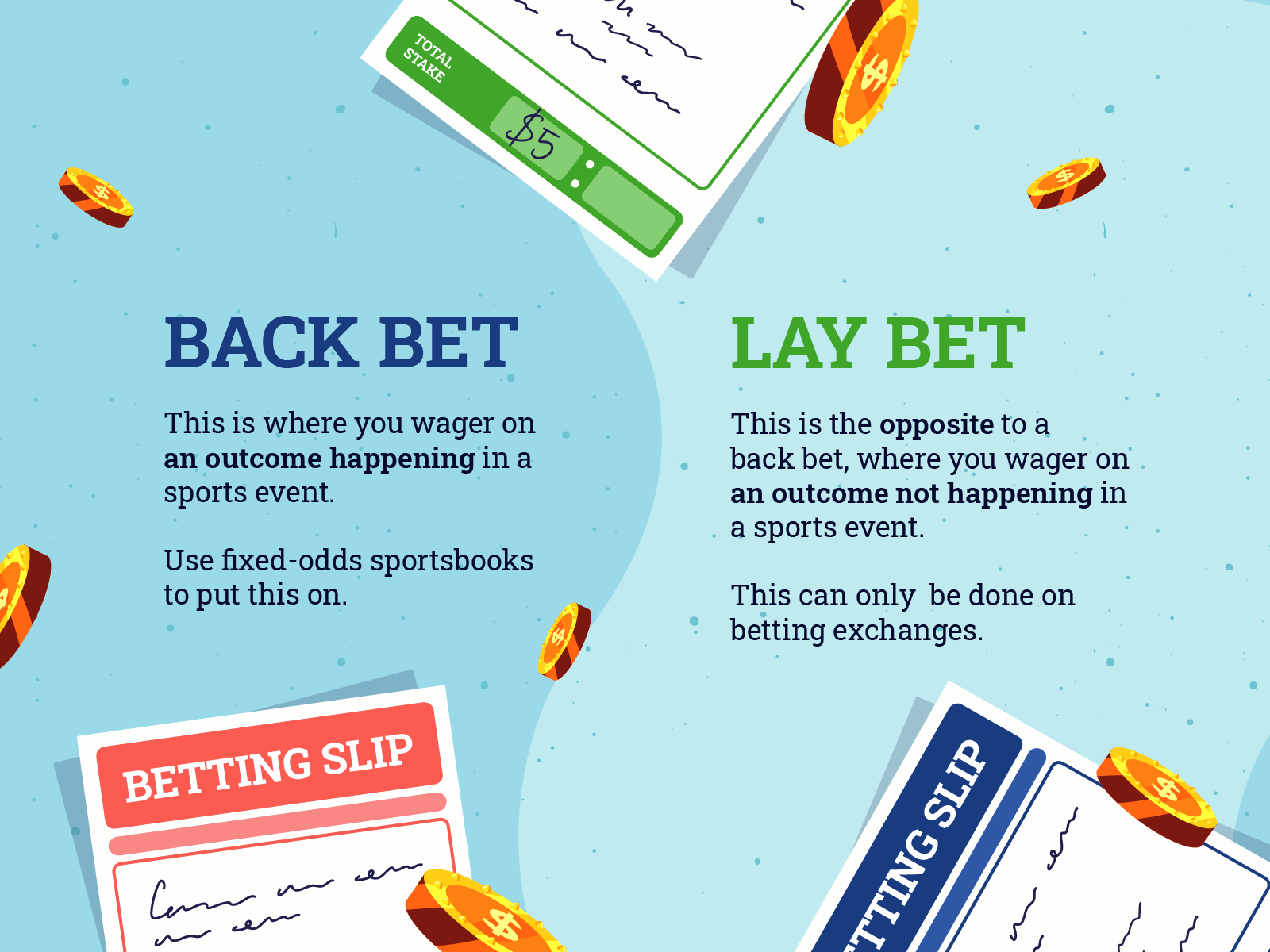
- Back and lay: back an outcome at a bookmaker, then lay (bet against) the same outcome on a betting exchange. The back odds must be higher than the lay odds.
- Sportsbook vs. prediction market: buy the opposing outcome on a prediction market, or pair two prediction markets against each other. More on that below.
How Arbitrage Betting Works: A Worked Example
Say Sportsbook A offers Team A at +108 (2.08 in decimal odds) and Sportsbook B offers Team B at +104 (2.04). The implied probabilities are 48.08% and 49.02%, which add up to 97.1%. That 2.9-point gap is the arb.
To lock it in, split your total stake so both outcomes pay the same amount. The formula is: stake on each side = total stake × (1 ÷ odds) ÷ sum of (1 ÷ odds). With $1,000 to stake, that works out as follows.
| Bet | Odds | Stake | Total return | Net profit |
| Team A at Sportsbook A | +108 (2.08) | $495.15 | $1,029.90 | $29.90 |
| Team B at Sportsbook B | +104 (2.04) | $504.85 | $1,029.90 | $29.90 |
Whichever team wins, you collect $1,029.90 on a $1,000 outlay, a profit of about 3%. These odds are illustrative. Real arbs this size are rare and rarely last. A scanner or arbing calculator does this math for you, but it pays to understand it so you can check the numbers before you bet.
Back-and-Lay Arbitrage on a Betting Exchange
A back-and-lay arb pairs a bookmaker’s price with an exchange, where you can bet against an outcome. Exchanges charge commission on your winnings, so include it in the calculation. The 2% used below is for illustration. Rates vary by exchange and market.
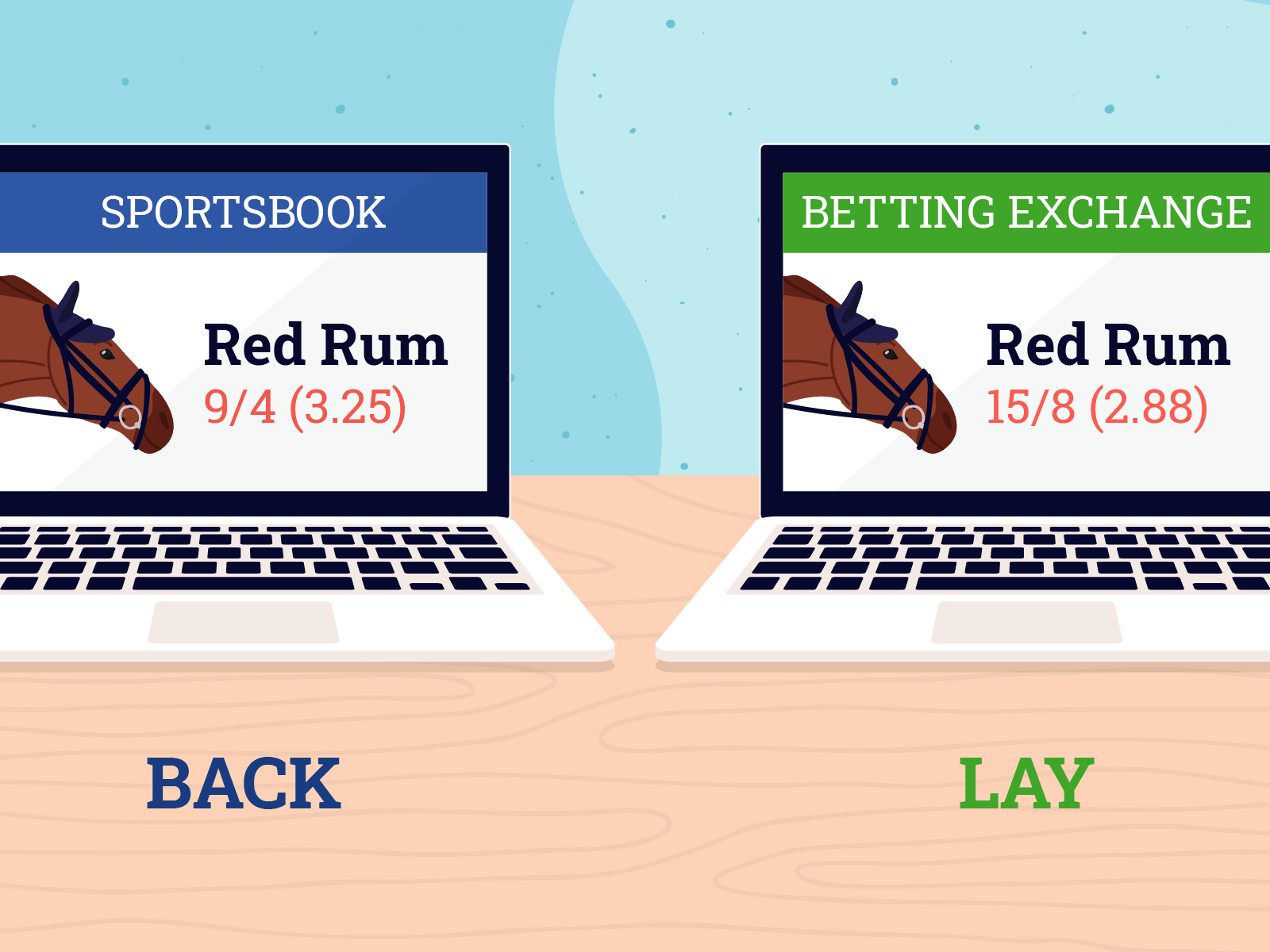
Take a hypothetical horse race. Red Rum is 9/4 (3.25 in decimal odds) with the bookmaker, and can be laid at 15/8 (2.88) on the exchange.
- Back Red Rum for $100 with the bookmaker.
- The lay stake is $113.64: $100 × 3.25 ÷ (2.88 − 0.02).
- Your exchange liability, the amount you must hold to cover a Red Rum win, is $213.64 ($113.64 × 1.88).
- If Red Rum wins, the back bet pays $225 profit. Subtract the $213.64 liability and you are up $11.36.
- If Red Rum loses, you lose the $100 back stake but win the $113.64 lay stake, less 2% commission. That is also about $11.36 up.
That is a modest profit on one race, but it adds up if repeated. Traditional lay exchanges such as Betfair are mainly a UK and European feature. In the US, the closest equivalents are CFTC-regulated prediction market exchanges. For more on how the venue types differ, see our comparison of betting exchanges, sportsbooks and prediction markets.
Prediction Market Arbitrage: How It Works
Prediction markets have given arbers a new place to look. Here is how prediction markets work: on platforms like Polymarket, Novig and ProphetX, you buy contracts that pay $1 if an outcome happens and $0 if it does not. The price in cents doubles as the market’s implied probability, so a 50-cent contract implies a 50% chance. Because traders set these prices rather than a bookmaker’s odds compilers, and the price itself carries no built-in vig (fees are charged on the trade), they sometimes differ from sportsbook lines on the same game.
Sportsbook vs. Prediction Market: A Worked Example
To compare the two, convert the sportsbook price into the cost of a $1 payout. Odds of +120 are 2.20 in decimal, so a $1 payout costs about 45.5 cents (1 ÷ 2.20).
Say a prediction market sells “Team A wins” at 50 cents, and a sportsbook offers Team B at +120. The two legs cost 95.5 cents combined for a $1 payout, a gross gap of 4.5 cents. Now add fees. For illustration, assume a trading fee of 2 cents per contract. That takes the total cost to about 97.5 cents and the margin to about 2.5 cents on the dollar. Scaled up to a $200 payout:
| Leg | Price | Cost | Fee | Pays if it wins |
| Prediction market: Team A “Yes” | 50¢ × 200 contracts | $100.00 | $4.00 | $200.00 |
| Sportsbook: Team B | +120 (2.20) | $90.91 | — | $200.00 |
| Total | $194.91 | $200.00 |
Either team winning returns $200 on $194.91 spent, a profit of $5.09, or about 2.6%. Real fees vary by platform and order type, so check the current fee schedule before you run your own numbers.
Prediction Market vs. Prediction Market
Arbs can also appear between two prediction markets. If one platform sells “Yes” on an outcome at 55 cents and another sells “No” on the same outcome at 42 cents, you spend 97 cents for a guaranteed $1 payout before fees. Both platforms quote in cents, so there is no odds conversion, but spreads are tight and thin liquidity can ruin a fill.
The bigger danger is resolution risk. The two contracts must settle on exactly the same condition. Platforms can word markets differently, use different settlement sources, set different deadlines, and handle cancellations differently. A near match is not an arb. It can leave you holding two positions that do not offset, and a mismatch can turn a “sure thing” into two losing bets. Read both rule sets word for word before you trade.
Why Prediction Market Arbs Are Harder Than They Look
- Fees: trading fees on some platforms are highest near 50 cents, where many sports contracts trade, and they come out of a margin of only a few cents.
- Two pools of collateral: your sportsbook and exchange positions are not netted. You fund both legs in full, which ties up twice the capital and lowers your return on money at work.
- Slippage and liquidity: the price can move between your two bets, and a thin order book may not fill at the quoted price.
- Resolution mismatches: two contracts that look identical may not settle the same way.
- Sportsbook limits: the sportsbook leg of the trade is still exposed to stake limits and account restrictions.
Which Prediction Markets Offer Sports Contracts?
As of October 2026, sports event contracts are available on Polymarket, Novig, ProphetX, Kalshi and the prediction market apps run by DraftKings and FanDuel. Availability varies by platform and by state, and some offer sports contracts in only a portion of the states where they operate. Check each platform’s eligibility rules for your state before you fund an account. Our list of prediction market apps tracks which ones are live.
Is Prediction Market Arbitrage Legal?
Trading event contracts and comparing them against sportsbook odds is not illegal, but where you can access sports contracts depends on your state. Federal courts are split on whether federal law overrides state gambling law for these contracts. The Third Circuit sided with a prediction market operator against New Jersey, while the Ninth Circuit (Nevada) and, in September 2026, the Sixth Circuit (Ohio and Tennessee) let states apply their gambling laws. New Jersey has asked the Supreme Court to review the Third Circuit decision. Other states, including Massachusetts, have also moved to restrict sports contracts. Rules can change quickly, so confirm the current position where you live. Our explainer on who regulates prediction markets covers the federal side in more detail.
Is Arbitrage Betting Legal?

Yes. No US law prohibits arbitrage betting, and the software that scans odds for arbs is legal to use. The risk is commercial, not criminal. Sportsbook terms let operators limit stakes, void bets and close accounts at their discretion, and arbers are a frequent target because they win without taking much risk.
The usual consequences are lower maximum bets, restricted promotions and, in some cases, a closed account. Sportsbooks also void bets they consider pricing errors, which can leave one leg of an arb unhedged. Keep that in mind before you stake serious money.
Taxes matter too. Gambling winnings are generally taxable income in the US, and prediction market gains can be treated differently from sportsbook winnings. See our guide on how prediction markets are taxed, and talk to a tax professional about your situation. This is general information, not legal or tax advice.
Best Events and Markets for Arbing
Arbs can show up in any sport, but popular events work best. NFL, NBA, MLB and NHL games, major soccer fixtures and big horse races attract heavy betting volume, many sportsbooks and frequent price moves, which is where gaps open up. Obscure events stand out more to bookmakers and often have thin prediction market liquidity.
Two-way markets such as moneylines, spreads and totals are the easiest to calculate because there are only two outcomes. Three-way soccer markets need three legs and more capital. Player props often show wider gaps between books, but they also carry a higher risk of voided bets, limits and pricing errors. Our prop betting guide explains how those markets work.
Spotting arbs by hand across every book and exchange is not realistic, so most arbers use scanning software that compares odds and prices in real time. These tools are legal. Just remember that the price on screen may be gone by the time you place the bet.
Tips for Successful Arbitrage Betting
1. Move Fast and Use Alerts
Odds move constantly. Use a scanner with alerts, and place the leg most likely to move first, usually the sportsbook line or a thinly traded prediction market contract. Placing the steadier leg second reduces the chance of being stuck with one side.
2. Confirm Both Bets Cover the Same Market
Check the rules on each side. Does the market include overtime? What happens on a push, a postponement or a player who does not play? On prediction markets, how does the contract resolve? A rules mismatch is the most common way an arb becomes a loss.
3. Keep Your Stakes Believable
Large stakes stand out, especially if you normally bet small. Bigger stakes make more sense on major events where betting volume is high. Whatever you do, never stake more than you can afford to lose.
4. Spread Your Action Across Platforms
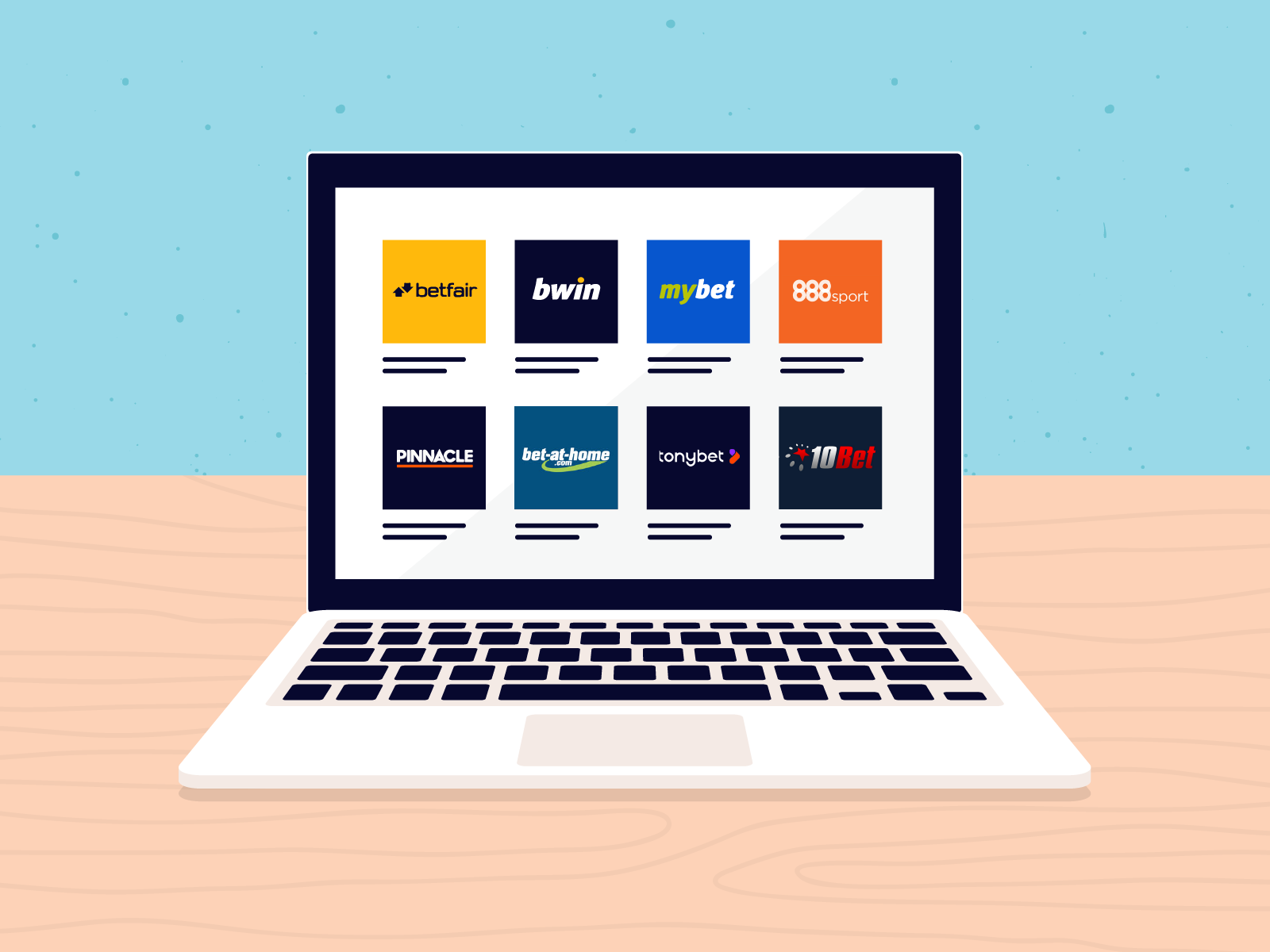
Arbitrage means getting the best price on each side, so one sportsbook is rarely enough. Keep funded accounts at several sportsbooks and, where they are available in your state, one or two prediction markets so you can act when a gap appears. Stick to one account per operator. Opening duplicates breaks the terms and can cost you your winnings.
5. Calculate Net of Fees and Set a Minimum Margin
Subtract exchange commission and prediction market fees before you decide an arb is worth taking. Set a minimum net margin and skip anything below it, since a small error or a bit of slippage can turn a thin arb negative.
6. Track Everything and Manage Your Bankroll
Record every leg, fee and outcome. Good records help at tax time and show you which platforms and markets actually pay off. Prediction market strategies built on price discipline and position sizing apply here too.
Final Thoughts on Arbitrage Betting
Arbitrage betting offers something rare in gambling: a mathematical edge. But thin margins, fast-moving odds, fees and the risk of restricted accounts mean it is far from free money. Prediction markets have widened the hunting ground, and they have also added new costs, collateral requirements and state-by-state legal uncertainty. Double-check every leg before you place it, and never stake more than you can afford to lose.
Frequently Asked Questions
What is arbitrage betting?
Arbitrage betting, or arbing, is betting on all outcomes of an event at odds from different sportsbooks, exchanges or prediction markets that together guarantee a profit regardless of the result.
Is arbitrage betting really risk-free?
Mathematically, a correctly placed arb pays the same whichever outcome occurs. In practice, odds can move before you place the second bet, bets can be voided, fees can erase the margin, and accounts can be limited. It is low risk when everything goes to plan, not risk-free.
Is arbitrage betting legal in the US?
Yes. There is no law against it, and arb-scanning software is legal. Sportsbooks can still limit or close accounts under their own terms.
Can you arbitrage on prediction markets?
Yes. You can pair a prediction market contract with a sportsbook bet, or pair contracts on two prediction markets. Fees, collateral on both platforms, liquidity and resolution rules all affect whether the trade is actually profitable, and sports contract availability varies by state.
Do sportsbooks ban arbers?
They can. Sportsbooks monitor accounts that win consistently and may lower limits, restrict promotions or close accounts. Holding accounts at several operators spreads that risk.
How much can you make from arbitrage betting?
Margins per arb are typically small, so profit depends on volume, bankroll and how quickly you act. Results vary, and no profit is guaranteed.
Do you need software to find arbs?
No, but it helps. Odds change within seconds, and checking every sportsbook and prediction market by hand is slow. Scanners and calculators speed up both finding arbs and working out stakes.
Sources
Massachusetts Attorney General, court order blocking unlicensed sports wagers on a prediction market (mass.gov)
CNBC, “Appeals court rules that states can regulate sports prediction markets” (September 25, 2026)
CNBC, “Novig wins CFTC approval as competition intensifies in sports prediction markets” (June 16, 2026)
OddsShopper, “Prediction Market Arbitrage: How It Works” (July 19, 2026)
Covers, “DraftKings Predictions Launches in 38 States” (December 2025)