How Prediction Markets Called the 2025 Nobel Peace Prize, and What It Means for 2026

Summarize this post
Key highlights
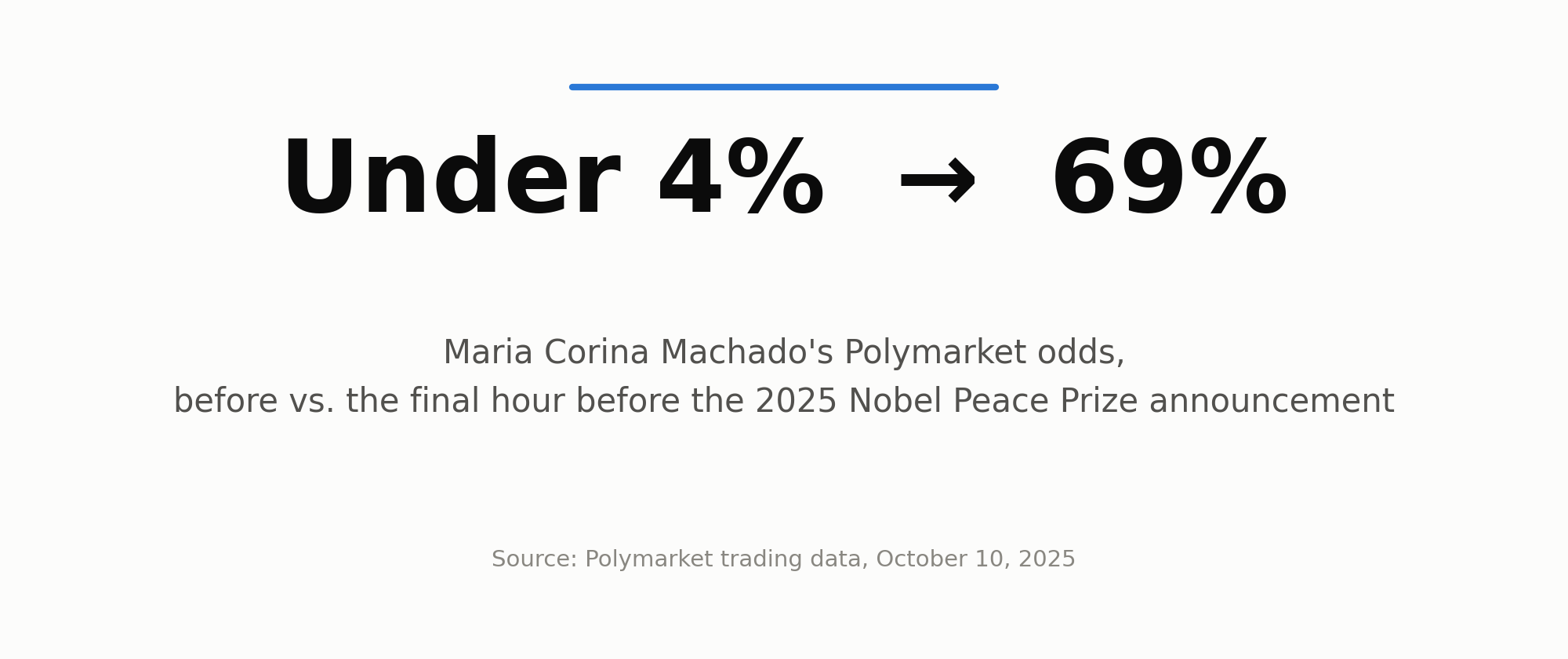
- In the final hour before the October 2025 announcement, Maria Corina Machado’s Polymarket odds jumped from under 4% to about 69%, correctly calling the winner.
- The surge came from newly created accounts with no prior betting history, and Norwegian officials opened a formal leak investigation soon after.
- By February 2026, the Norwegian Nobel Institute concluded a cyberattack was the “most likely” source of the leak, though it could not identify who was responsible.
- The 2026 winner is announced October 9, and as of this writing in early September, no candidate on Polymarket has broken into double digits.
How prediction markets actually called the 2025 winner
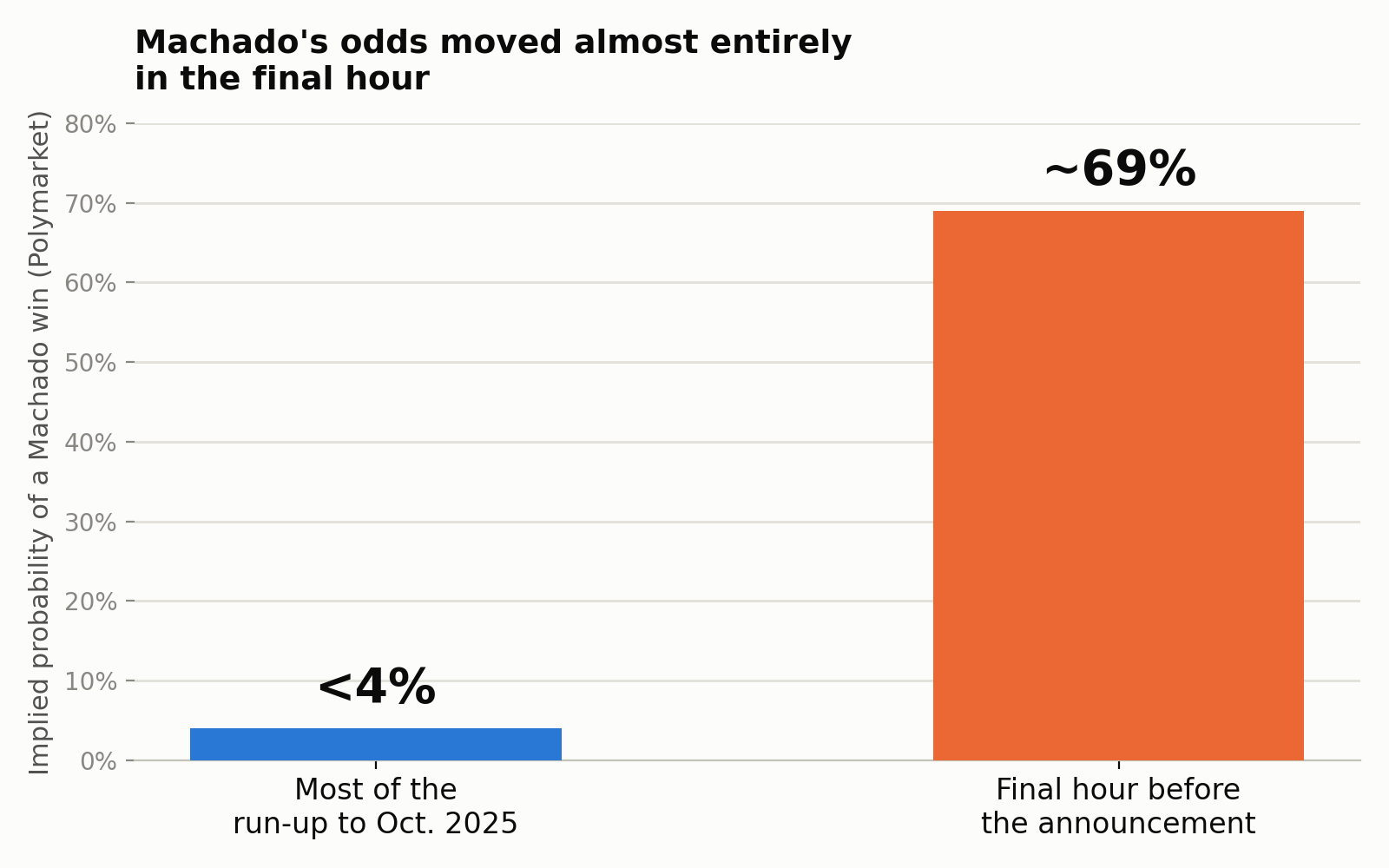
For most of 2025, Maria Corina Machado wasn’t close to the center of the conversation. Two days before the announcement, odds had Yulia Navalnaya as the favorite at roughly 34% implied probability, followed by Sudan’s Emergency Response Rooms near 25%, Donald Trump near 21%, and Volodymyr Zelenskyy near 18%. Machado, meanwhile, was trading under 4% on Polymarket, barely registering as a potential outcome.
Then, in the hour before the Norwegian Nobel Committee’s announcement, that changed fast. Machado’s implied probability on Polymarket spiked from under 4% to roughly 69%, and more than $1.8 million flowed into bets on her winning as the market corrected in something close to real time. When the committee named her the laureate minutes later, they were just confirming what the prediction markets had already called.
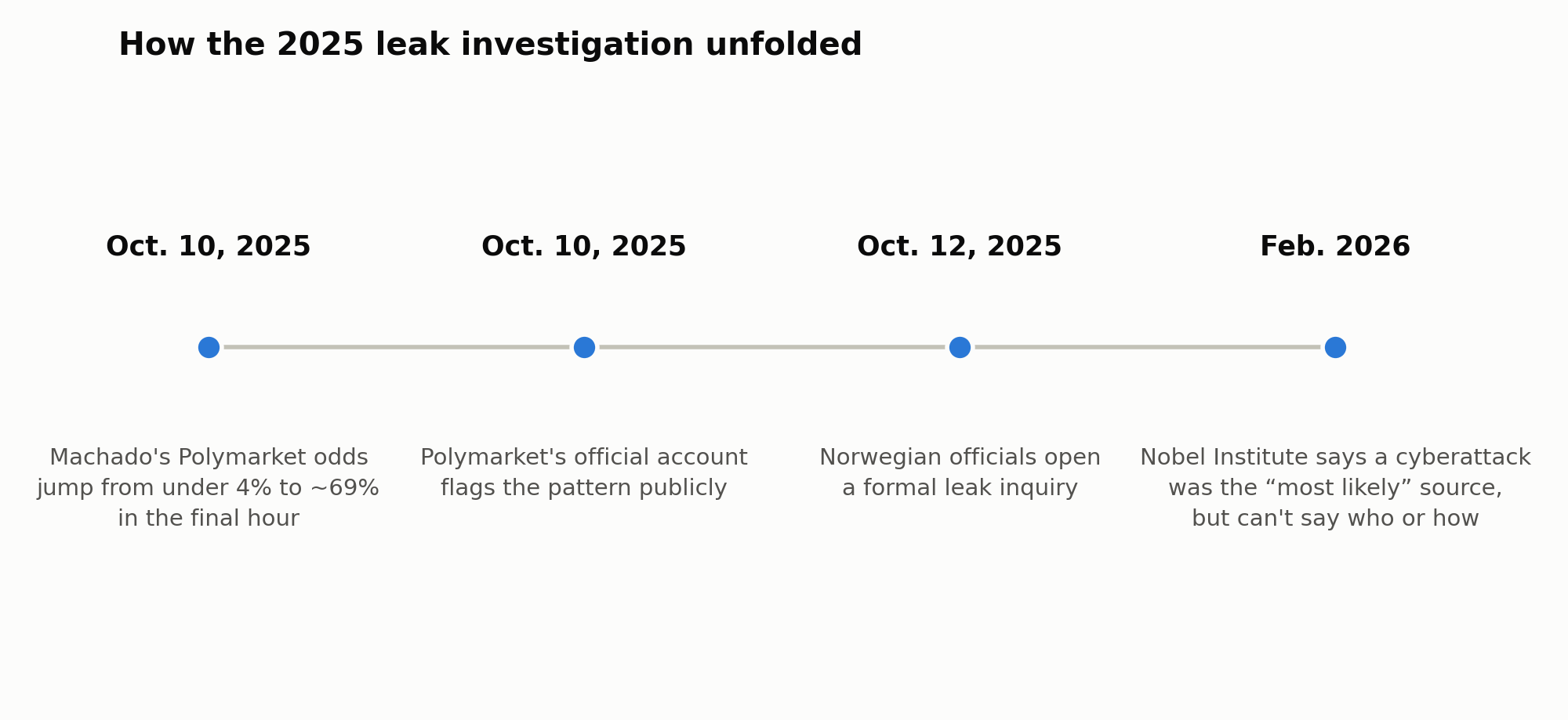
The way it called it is what set off alarms. The bets that moved the price came almost entirely from accounts created only weeks earlier with no other trading history. One account, using the handle “dirtycup,” turned a roughly $70,000 bet into about $30,000 in profit. Two more accounts trading almost exclusively on Machado added a combined $90,000 in winnings. Polymarket’s own official account flagged the pattern publicly the same day, and Norwegian authorities opened an inquiry into whether someone with access to the committee’s sealed deliberations had tipped off traders.
Interestingly, most other sites did not see the same price surge. Predictit, for example, did not have any sudden movements in Machado odds. They ldid not have sufficient liquidity to take on unexpected last minute action with the same volume Polymarket did.
What investigators found
The inquiry ran for months. By February 2026, the Norwegian Nobel Institute, working with the country’s intelligence services, concluded that a cyberattack was the “most likely” explanation for how information about Machado’s win reached traders before the public announcement. The Institute also acknowledged real limits to what it could establish. It said it was unable to determine precisely how the information was obtained, who bought it, or whether a state or private actor was behind it. Institute officials announced enhanced security measures ahead of the 2026 prize but declined to detail them, citing operational reasons.
Why the process is built for this kind of surprise
Part of why a leak like this is even possible comes down to how closed the Nobel Committee’s process is. Nomination rights belong to a narrow group: sitting heads of state, national legislators, university professors in relevant fields, past laureates, and a handful of others named in Alfred Nobel’s will, with a nomination deadline of January 31 each year. From there, the five-member Norwegian Nobel Committee builds a shortlist, consults outside advisers over the spring and summer, and votes on a winner by majority shortly before the October announcement.
Nominee names, nominator identities, and internal deliberations stay sealed for 50 years. There’s no public shortlist to trade on and no legitimate way for outside bettors to know the outcome early. That’s exactly what makes the 2025 spike so notable. Under normal conditions, a Nobel Peace Prize market should stay uncertain until the announcement itself, because there’s nothing public to price in beyond speculation.
What this means for reading prediction markets
The 2025 episode is a useful lesson in how to weigh a Nobel Peace Prize market at different points in the cycle. Through most of the year, the pricing mostly reflects informed public opinion: name recognition, current events, and the committee’s past patterns. That’s a reasonable, if imperfect, guide. It’s also why raw betting volume on prediction markets isn’t necesasarily the same as being the favorite: Donald Trump drew nearly $14 million in Polymarket bets on the 2025 peace prize outcome, more than any other candidate, and still didn’t win. On the other hand, he also drew heavy volume in his presidential race, and the political prediction markets definitely got that right.
In the final hours before the announcement, the picture can change entirely. A late, sharp move might mean the crowd has picked up on a genuine signal, or it might mean, as in 2025, that a small number of accounts with privileged information are trading ahead of everyone else. Both can look identical on a price chart in the moment. The only real tell in 2025 was the account histories behind the trades, and that kind of detail usually isn’t visible to someone just watching the odds move on results day.
What it means for the 2026 prize
The 2026 winner is announced October 9, and as of early September, the market looks nothing like it did in the final hour of 2025. No candidate on Polymarket is trading above single digits, with Yulia Navalnaya and the refugee agency UNRWA drawing the most interest so far, followed by Volodymyr Zelenskyy, the International Court of Justice, and Pope Leo XIV. That kind of fragmented field, with no runaway favorite this early, looks a lot like how the 2025 market sat for most of the year, right up until its final-hour turn.
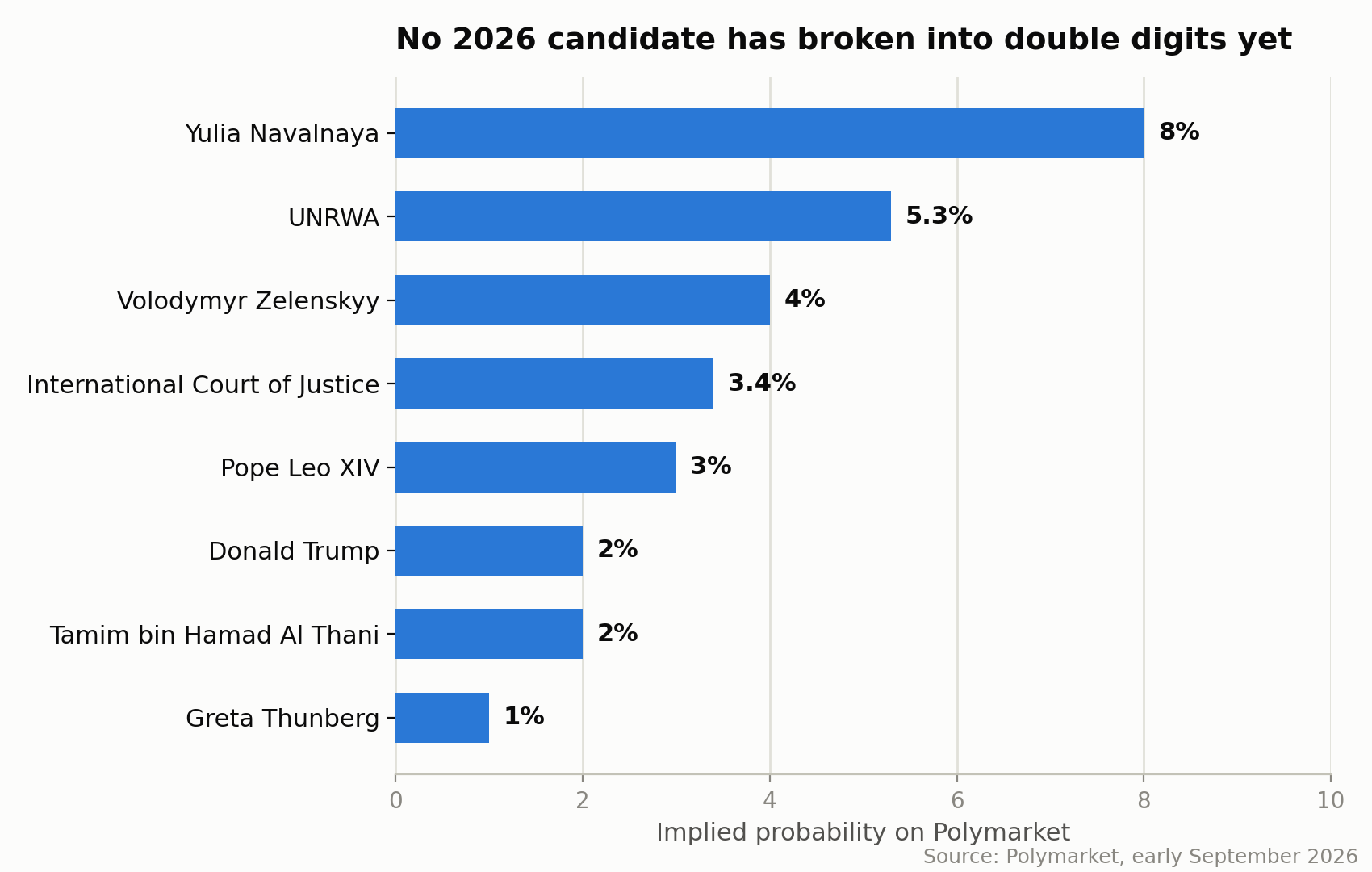
If last year is any guide, the moment worth watching isn’t early September. It’s the days, and especially the final hours, before October 9. Given the scrutiny the 2025 episode brought, a sudden, sharp move this year deserves two readings at once: as a possible genuine signal, and as the exact pattern regulators and Polymarket itself are now watching for.
A few ground rules for following this market
- Treat the current field as wide open. With nothing above single digits on Polymarket, the market is telling you it doesn’t have a strong read yet, not that a quiet favorite has already emerged.
- Weigh the committee’s own patterns alongside the odds. Sitting heads of state and active wartime leaders have historically fared worse than humanitarian organizations and opposition figures, a pattern that lines up with Machado’s own win.
- Watch the final 24 to 48 hours more closely than the weeks before. That’s when the 2025 market actually moved, for reasons that took Norwegian investigators four months to partly explain.
- Don’t treat a late spike as confirmation on its own. Last year’s most decisive market move came from accounts with no trading history, not gradual public consensus.
What Casino.org’s expert says
“Last year’s market didn’t get better at predicting the Peace Prize until about an hour before the announcement, and even then it wasn’t really public wisdom that moved the price. That’s the trap with this event. A market that looks quiet in September can look completely different in the last hour of trading, and in the moment, you generally can’t tell whether that’s a real signal or something else.”
– Chris Jonat, Content Manager at Casino.org
Frequently asked questions
Did prediction markets predict the 2025 Nobel Peace Prize winner?
Technically, yes, though in an unusual way. Maria Corina Machado’s odds on Polymarket sat under 4% for most of the run-up, then jumped to about 69% in the final hour before the announcement after a wave of betting from newly created accounts. Norwegian officials later investigated the surge as a possible information leak.
What did investigators conclude about the 2025 betting spike?
By February 2026, the Norwegian Nobel Institute said a cyberattack was the most likely source of the leak, based on work with the country’s intelligence services, but it could not determine exactly how the information got out or who was responsible.
When is the 2026 Nobel Peace Prize announced?
Friday, October 9, at 11:00 CEST, by the Norwegian Nobel Committee in Oslo.
Who is currently favored to win in 2026?
No one, decisively. Polymarket trading is split across candidates like Yulia Navalnaya and UNRWA, with nothing above single digits as of early September.
Can I legally trade Nobel Peace Prize prediction markets in the US?
Yes, on CFTC-regulated exchanges such as Polymarket’s US-facing exchange, which lists event contracts on the Peace Prize outcome. Availability can vary by state, so check a platform’s terms before trading.