 Main menu


Financial
DraftKings Prediction Exchange Margins Flirting with Sportsbook Levels
Posted on: November 11, 2026, 04:43h.
Last updated on: November 12, 2026, 04:35h.


Key Points
- DKeX’s net revenue margins are rapidly closing in on the levels seen at DraftKings Sportsbook
- The strong unit economics serve as validation for the company’s vertically integrated prediction market strategy
- Robust margins may also help allay investor concerns regarding the operator’s heavy prediction market expenditures


Barely six months after launching, DraftKings’ (NASDAQ: DKNG) DKeX prediction market exchange is already posting net revenue margins that rival traditional sportsbook hold.

In a new report, Eilers & Krejcik Gaming (EKG) analyst Brad Allen notes that while volume is swelling on DKeX, net revenue margins generated by the exchange are getting close to those found on DraftKings Sportsbook—one of the company’s core segments.
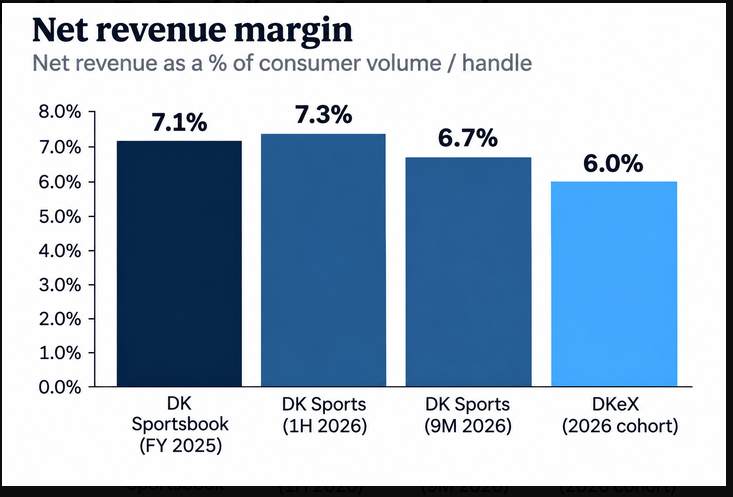
DKeX generated $56.8 billion in annualized total trading volume in October on consumer volume (a handle equivalent) of $10.1 billion, implying a 5.6x gap between headline exchange activity and underlying customer staking,” notes Allen. “Of that consumer volume, DK converts 7.3% into gross revenue through fees and market-making. After accounting for promos, 6% of consumer volume is converted to net revenue.”
He adds that DKeX’s current net revenue margin compares with 7.3% for the operator’s broader sports unit in the first half of 2026 and 6.7% over the first nine months of this year.
Why DKeX Margins Matter
At a prediction market industry event last month, DraftKings CEO and co-founder Jason Robins noted that DKeX, which is an in-house exchange, has rapidly ascended to the third spot among prediction market exchanges.
That fast rise coupled with the aforementioned net revenue margin bullishness could assuage skittish investors who have been fretting about DraftKings’ prediction market spending.
When the sportsbook giant reported third-quarter results last week, it told investors it expects an adjusted earnings before interest, taxes, depreciation, and amortization (EBITDA) investment of $650 million to $700 million in DraftKings Predictions. The stock slid on that news, but has since clawed back some of those losses.
While shareholders weren’t initially keen on DraftKings’ prediction market spending plans, the rising revenue margins coupled with market-making revenue may be indications that the company will realize long-term top- and bottom-line contributions from its event contracts business.
“Prediction markets may be producing revenue per dollar of customer activity that is not far off traditional sportsbook levels,” adds Allen.
DraftKings Has Cards to Play
While DraftKings stock has been battered over the past year, catalysts are lining up—particularly if the US Supreme Court delivers clarity on the fate of sports event contracts. The worst-case scenario is that the high court strikes down sports derivatives, yet that is primarily an existential threat to pure-play prediction market operators rather than incumbents like DraftKings that are already entrenched in regulated sports wagering.
There is also growing optimism that following last week’s midterm elections, coveted holdout states such as Georgia and Texas could reconsider legalizing sports wagering” makes the closing sentence land with much more authority.


 Most Read

Another Shooting Near Las Vegas Strip Casino Injures Man
 973,132 views

Vintners Oppose Napa Valley Casino
556,715 views


Conversation (0)
Be the first to comment on this article.