
Is Dave & Buster’s a Family-Friendly Arcade or Illegal Gambling Outfit? Lawsuit Argues the Latter
Posted on: April 22, 2026, 08:17h.
Last updated on: April 22, 2026, 08:17h.

- Dave & Buster’s is accused of running illegal gambling games in South Carolina
- The lawsuit contends that skill games and redemption games are prohibited in the Palmetto State
- Dave & Buster’s sells more than $1.3 billion a year in game credits
Dave & Buster’s is being sued in South Carolina on allegations that the entertainment and restaurant chain is running an illegal gambling enterprise.
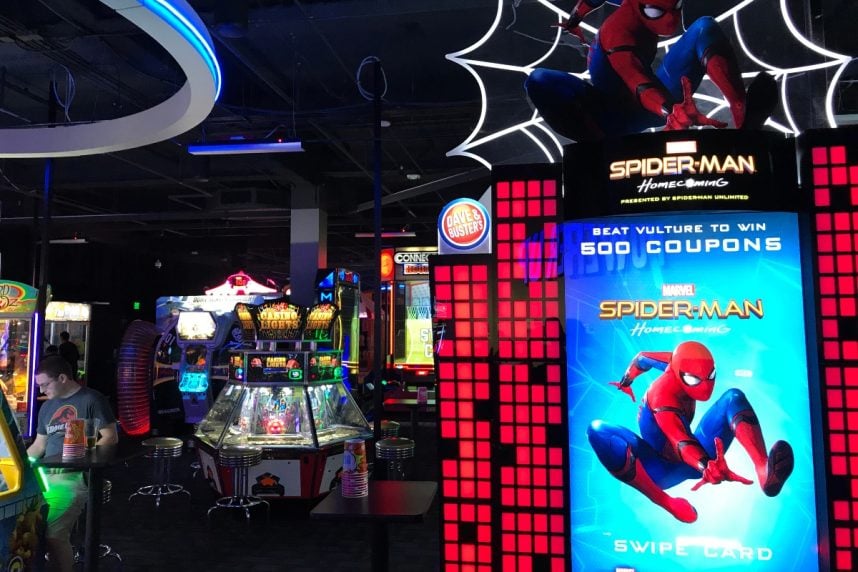
A group of business owners filed a lawsuit as SC Citizens for Equal Enforcement of Gambling Laws against Dave & Buster’s Entertainment, Inc., on allegations that the company is operating “unlawful redemption gaming machines” at its three properties within the state.
Defendant’s redemption gaming machines permit patrons to deposit money for the purpose of trying to ‘win’ more by playing games of skill or chance. The prizes available at Defendant’s in-store redemption centers include high-value electronics and consumer goods. This ‘opportunity to win’ constitutes gambling under South Carolina law, and Defendant is therefore the ‘winner’ of gambling losses sustained by patrons,” the federal complaint alleges.
The action was filed in South Carolina’s US District Court in Florence.
Gaming in South Carolina
South Carolina is one of only four states that continues to prohibit casinos, sports betting, iGaming, racinos, parimutuel wagering, and charitable gaming. The only legal form of gambling in the Palmetto State is the state-run lottery.
Skill games are also illegal. SC Citizens for Equal Enforcement of Gambling Laws claims the South Carolina Law Enforcement Division (SLED) has been inconsistent in enforcing the skill games law, raiding certain businesses that have offered redemption video and skill games while allowing Dave and Buster’s to function as a quasi-casino, where players purchase gameplay credits, similar to casino “chips.”
D&B’s annual report for the 2024 fiscal year reported that the entertainment offerings generated a gross margin of approximately 91.5%. Players spent almost $1.4 billion on the Dave & Buster’s games during the fiscal year. Prizes and operating costs were $118.6 million, for a net profit of $1.27 billion across its 232 locations.
The company generates the bulk of its revenue from its games, and the arcade is also Dave & Buster’s most profitable segment.
The complaint cited two slot-like games called the “Spin-N-Win Wheel” and “Spin Out,” where players stake game plays for a chance to win more game plays than they bet. Many other games, the complaint alleges, feature bonus ticket rounds and jackpot features.
Winnings, the lawsuit claims, can be redeemed for high-value items, such as an Apple iPad Air, a Sony PlayStation, an Xbox, and a Brookstone robotic vacuum.
SC Citizens for Equal Enforcement of Gambling Laws is seeking the return of three times the entertainment losses incurred by all customers over $50 during a single visit. The plaintiff additionally seeks the awarding of reasonable attorney’s fees, half of the total compensation awarded to the impacted consumer class, and the declaration that Dave & Buster’s operates illegal gambling under South Carolina law.
Dave & Buster’s has not yet responded to the complaint.
D&B Previously Caused Controversy
This isn’t the first time Dave & Buster’s games have caused criticism.
In 2024, Casino.org reported that the company fielded warnings from state gaming regulators after announcing an in-app feature to allow users aged 18+ to bet small stakes against their friends on certain skill games like skee-ball, basketball, and air hockey.
While peer-to-peer bets on the D&B Rewards app remain available in most states, they are prohibited in Ohio, Pennsylvania, Illinois, and Nevada, states that cautioned the company that the in-app feature could be in violation of their state gaming laws.
No comments yet