 Main menu

Prediction Markets
Jefferies: Prediction Market Daily Volume Surges 80% in June, Sports Accounts for 89%
Posted on: July 2, 2026, 07:12h.
Last updated on: July 3, 2026, 03:51h.


Key Points
- Kalshi outpaced the broader prediction market industry in June, with its average daily volume (ADV) jumping 90% on a sequential basis
- Sports contracts continue to drive the majority of the market's activity, accounting for a dominant 67% share of total daily volume last month
- Showing a massive appetite for non-wagering markets, non-sports volume nearly doubled in June with a 93% month-over-month spike


With a big assist from sports event contracts, average daily volume (ADV) across the prediction market industry swelled 80% on a month-over-month (m/m) basis in June, reaching $1.7 billion, according to latest Jefferies data.
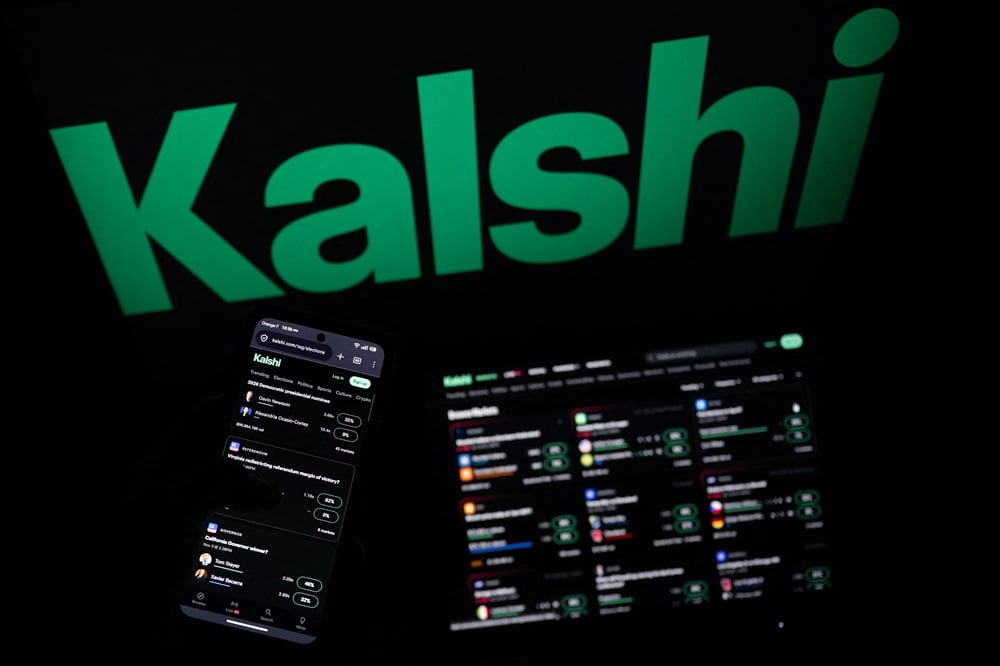
In a new report to clients, Jefferies analyst Daniel Fannon points out that Kalshi, the largest yes/no exchange operator, outpaced the industry last month in terms of both ADV and open interest growth.
On a sequential basis, Kalshi’s ADV surged 90% last month while open interest on the platform jumped 94%, well ahead of the broader industry increase of 64%.
Some projections indicate Kalshi controls an estimated 90% share of the domestic prediction market and the June data cited by Jefferies aren’t far off that mark. The research firm notes that Kalshi’s June ADV was $1.1 billion with rival Polymarket seeing average daily turnover of $469 million.
Put another way, just two prediction markets controlled nearly $1.6 billion of the industry’s June ADV of $1.7 billion. That dominance is also evidence across open interest (OI).
“Kalshi generated $1.21 billion of open interest (OI) in June (up 94% month-over-month; up 1,675% year-over-year), while Polymarket’s OI was $569 million (up 9% month-over-month; up 320% year-over-year). Polymarket’s OI market share declined to 30% (compared to 45% in May), while other platforms saw their OI market share increase to 7% (compared to 2% in May).”
Jeffries Analyst Daniel Fannon
OI refers to the total amount of active, unsettled contracts on a prediction market.
Sports Of Course, But There’s More
The preeminent ongoing legal and regulatory debate surrounding domestic prediction markets is whether or not these are sports wagering companies. In large part, criticism to that effect is born out of the prevalence of sports derivatives on platforms such as Kalshi and Polymarket.
While the industry is diversifying its product mix, sports event contracts are a major part of the business. Those derivatives’ ADV jumped 89% last month, but there was a bright spot in terms of 93% volume growth in non-sports category.
“Sports continues to hold a 67% share of total average daily volume (ADV), which is roughly in-line with May,” adds Fannon. “On the open interest (OI) side, non-sports has a 51% share of total OI, which is down significantly from 73% in May. In June, non-sports OI came in at $1.24 billion (up 37% month-over-month; up 972% year-over-year), while sports OI was $1.18 billion (up 246% month-over-month; up 5,648% year-over-year).”
Non-sports growth is essential because it can defray yes/no exchanges’ regulatory risk while proving to investors that growing valuations are justified by way of diverse product lineups.
June Brought Hot Prediction Market Competition
As Fannon notes, June was also interesting from a competitive standpoint. In the sixth month of the year, Rothera, a standalone entity in which Robinhood and Susquehanna International Group are investors, began taking on Major League Baseball and World Cup order flow that previously would have been routed through Kalshi.
Likewise, Cboe Global Markets rolled out Cboe Predicts on Interactive Brokers and Schwab while DraftKings debuted DKeX, its in-house exchange. That means DraftKings no longer needs to run yes/no trades through third parties.
Volume on Rothera is “already been strong, with $70 million ADV in June. On 6/26, DraftKings launched its proprietary prediction markets exchanges, DKeX, with $3.4 billion in annualized consumer volume and $11.3 billion annualized total trading volume for the week ending 6/21,” wrote Fannon.

 Most Read

Another Shooting Near Las Vegas Strip Casino Injures Man
 972,731 views

Vintners Oppose Napa Valley Casino
556,334 views


Conversation (0)
Be the first to comment on this article.