 Main menu

Politics
Trump’s Macau Ambitions Collided With a ‘Kabob Stand,’ New Letters Reveal
Posted on: October 8, 2026, 10:58h.
Last updated on: October 8, 2026, 10:58h.


Key Points
- Trump accused Macau’s courts of corruption after losing a trademark dispute with a local business operating under his name
- The future president sent Macau’s leader American TV ratings for The Celebrity Apprentice to demonstrate his international fame
- Trump’s unsuccessful 2001 casino bid preceded the trademark dispute, while renewed brand protections sparked ethics concerns in 2017


Donald Trump’s ambitions to establish his brand in Macau in the 2000s were hampered by a fast-food business that shared his name, which his lawyer disparagingly described as a “kabob stand.”
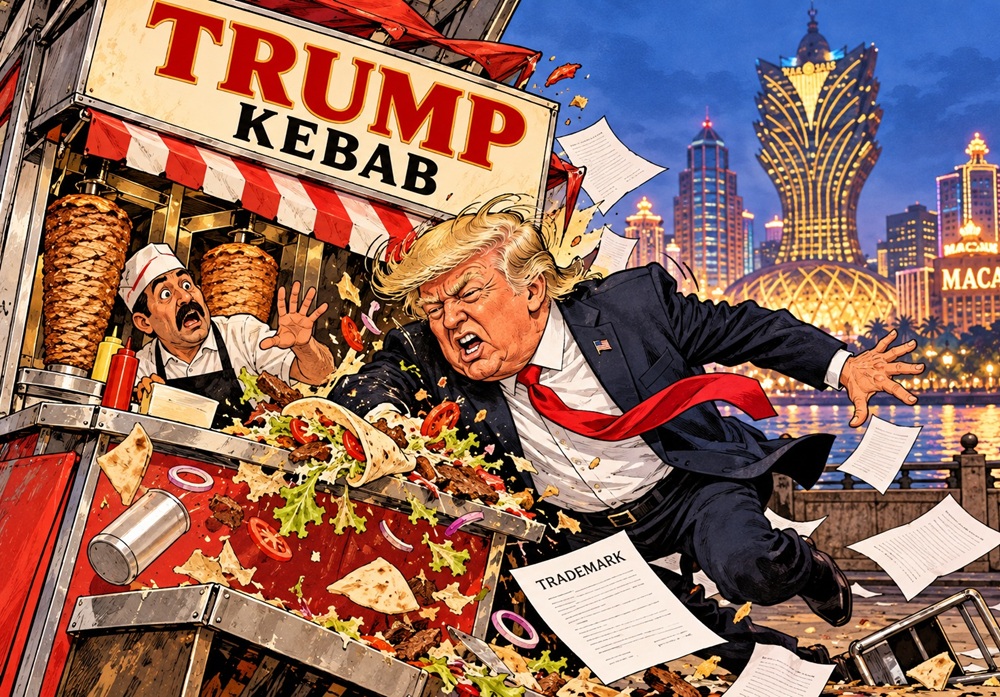
The dispute became so heated that the future US president appealed directly to Macau’s leader, accusing the territory’s courts of corruption and enclosing American television ratings to demonstrate how famous he was.
The extraordinary correspondence, obtained through a Freedom of Information Act request and published Tuesday (October 6) by the Hong Kong Free Press, sheds new light on Trump’s unsuccessful efforts to establish himself in the world’s biggest casino market.
Failed Casino Bid
Trump tried to enter the gaming sector in Macau in 2001 when he was part of a consortium that bid unsuccessfully for a casino concession, as the former Portuguese enclave was preparing to open its gambling market to international operators.
Despite this setback, he continued pursuing opportunities in the territory. By 2006, Macau had overtaken Las Vegas as the world’s biggest gambling market and Trump began applying for a range of trademarks, including for casino services.
But he was unable to get exclusive rights for the Trump name, because two Macau residents, Maria Cecilia Bastos Xavier and Wong Un Chon, had already incorporated Trump Companhia Limitada—Portuguese for Trump Company Limited—for their fast-food business.
‘A Terrible Thing’
Trump sued, demanding exclusive rights to his brand and 5 million Macau patacas (approximately $625,000) in compensation.
But in March 2010, a Macau court rejected his claim, finding that Trump and his company were not sufficiently well known among the territory’s general public.
“A terrible thing has recently happened to me in Macao,” Trump subsequently wrote to Macau Chief Executive Fernando Chui Sai On.
He described the ruling as an “outrageous miscarriage of justice” and urged Chui to intervene.
To demonstrate his international celebrity, Trump attached Nielsen ratings showing the popularity of The Celebrity Apprentice.
Trump argued in the letter that allowing him to establish his brand would bring investment, jobs, and world-class development to Macau.
He subsequently wrote to US Commerce Secretary Gary Locke in 2011, again attacking the territory’s judicial system.
Trump’s then-lawyer, Michael Cohen, also lobbied the US State Department, describing the dispute as an injustice involving a local resident who had appropriated the Trump name for a “kabob” stand.
Whether the establishment actually served kabobs remains unclear.
Approvals Raised Ethics Concerns
Trump’s local rival allowed its trademark to expire in 2016. A Trump-linked company secured approval for four Macau trademarks in June 2017, months after he became president. These replaced identical ones that had previously been granted but had lapsed earlier that year.
The approvals prompted concerns at the time that Trump’s foreign business interests could allow foreign governments to exert influence on the White House.

 Most Read
Another Shooting Near Las Vegas Strip Casino Injures Man
 972,491 views
Vintners Oppose Napa Valley Casino
556,118 views


Conversation (0)
Be the first to comment on this article.